Choosing the Right Vehicle for Towing in Australia
If you want to get the most out of any trailer type you're towing, in order to reduce sway and minimise wind resistance, or tow safely when travelling downhill or at a higher driving speed, it's important to have the right sort of towing vehicle for that size and category of trailer.
Most modern vehicles built for today's market can safely and legally tow smaller trailers, but if you plan regularly to tow a larger trailer type, such as a car trailer, beam trailer, mower trailer or stock crate trailer, you need to ensure that you have the right sort of vehicle that will be capable of towing it safely.
In this blog, we look at issues such as a vehicle's towing capacity, efficient braking systems, trailer weight, and how to ensure a trailer is properly secured to the tow bar, so that you can steer smoothly and enjoy safe, normal driving in all types of conditions.
Trailer ratings and a vehicle's towing capacity
There are a number of key ratings or measures that you need to be aware of when you are calculating the maximum towing capacity of a vehicle:
Kerb weight
This is how much a tow vehicle weighs when it has a full fuel tank, but without any other load onboard, such as passengers or equipment, and without its accessories e.g., a bull bar.
Gross vehicle mass (GVM)
The GVM of your vehicle will vary, as it combines the kerb weight with the loaded mass of the vehicle (including passengers), plus any accessories that have been fitted.
Gross combination mass (GCM)
This is the maximum permissible towing weight for the vehicle, and consists of the combined mass of the GVM and the trailer's ATM (see below).
Aggregate trailer mass (ATM)
This is the combined weight of the trailer with its full load when not coupled with a tow vehicle, and is the way we measure the carrying capacity of our trailers at Basic Trailers.
Gross trailer mass (GTM)
This is the weight that a fully loaded trailer imposes on its axle(s) when it is coupled to a towing vehicle.
Towing capacity and legal weight limits
A vehicle's towing capacity, which is the maximum ATM that the vehicle can tow safely according to Australian standards and other relevant legislation, can usually be found in the vehicle manufacturer's handbook.
Most 4WDs in Australia will have a rated capacity that means they can tow a 3,000 kg ATM or 3,500 kg ATM load, making them capable of towing a wide range of trailer types.
However, if you only use a smaller trailer occasionally with a lower carrying capacity to move garden waste, household rubbish or furniture every now and then, you won't need an especially large tow vehicle, as most family cars will meet the legal requirements and be in line with state and federal road rules.
Tow vehicle power and torque
When you're towing a trailer with an ATM of 2,800 kg or above, you not only need pulling power in your towing vehicle, but also require torque as well.
For towing heavier loads (including large caravans, boat trailers, camper trailers and horse floats ), you require a vehicle with a peak torque output that is spread across the rev range lower end, as this means it can maintain pulling power without needing to rev the engine too hard. This is especially important when you are starting up from stationery, when facing more wind resistance, using a lower gear, or when you have long hill climbs to negotiate.
On the whole, turbo-diesel engines perform the best in this area, as they produce more torque across a wider rev range, which is ultimately more important when towing a trailer than the torque that is developed at peak power.
Manual or automatic for a quality towing experience?
When considering transmission options for a towing vehicle, an automatic will generally be more fuel efficient and provide a better towing experience than a manual gearbox.
Most automatic 4WDs on the market in Australia will have between six and nine different ratios, which helps to maintain maximum power and torque. Also, modern automatic gearboxes make the shift between gears so swiftly that you tend not to lose momentum in the same way that you might when you change gears in a manual, especially important when towing a heavy trailer, or when towing in steep terrain.
A number of SUVs and 4WDs with automatic gearboxes also have driving modes designed specifically for towing trailers, and these can also help to produce better road performance and fuel efficiency even at maximum weight.
Wheelbase and track
A towing vehicle should ideally have as long a wheelbase as possible, combined with a wide track, if you are going to be towing heavier trailers consistently.
A long wheelbase generally produces a smoother towing experience, especially when accelerating and slowing down, as well as on uneven road surfaces. A wider track also helps in this regard, as it means you experience less roll when turning.
Other tips for safe trailer towing
In addition to choosing the right tow vehicle for your trailer, it's also important to ensure that both the vehicle and trailer have the right configuration and features to meet your specific needs.
Choosing the right trailer brakes
When buying a new trailer, it's important to opt for a braking system that will suit the rated capacity of the trailer you tow and is also compliant with towing regulations and road rules.
Trailers up to 750kg ATM do not require brakes, while for trailers with a 750kg - 2,000kg ATM, brakes are required on at least one axle. For multi-axle trailers with a 2,000kg+ ATM, electric brakes are required on both the front and rear axle.
Mechanical trailer brakes
Mechanical trailer brakes feature a cable connected to the hitch, and as the towing vehicle slows the momentum of the trailer activates the braking system. This will usually be an efficient braking system for smaller trailers that carry light loads up to 2,000kg ATM. Hydraulic brakes can also be fitted to trailers with an ATM trailer mass of 2,000kg or less to provide additional stopping capacity in a range of different road and weather conditions.
Electric trailer brakes
Electric brakes are operated by a brake controller in the towing vehicle. When the braking system is activated, an electrical current is sent to magnets in the wheel hubs that expand the brake shoes and create friction which then acts to slow down the trailer.
It is compulsory in SA for trailers with an ATM in excess of 2,000kg to have fitted electric brakes featuring a breakaway system. This automatically applies the brakes if the trailer gets separated from the towing vehicle, and for larger trailers this is the safest and most efficient braking system.
Hitching a trailer
To ensure that you are able to tow safely, it is essential that your trailer is properly connected and hooked up to the towing vehicle, and that all towing equipment is in good working order.
Hooking up a trailer is always quicker and easier when the trailer and towing vehicle are aligned in a straight line. It's also helpful to remember that a fully loaded trailer is difficult to manoeuvre by hand, so get your tow vehicle as close as possible in advance.
To begin the hitching process, back up the vehicle to the tow bar so that it's about 30cm from the tow coupling, then check that it is properly aligned. The tow coupling should then be raised until it’s about 5 to 10 cm higher than the tow ball using the jockey wheel.
The towing vehicle should then be backed up carefully so that the tow coupling is directly above the tow ball. It's best if someone can assist you in doing this, but if not use extended towing mirrors to check the position (it may also require stopping and getting out to check the distance and alignment).
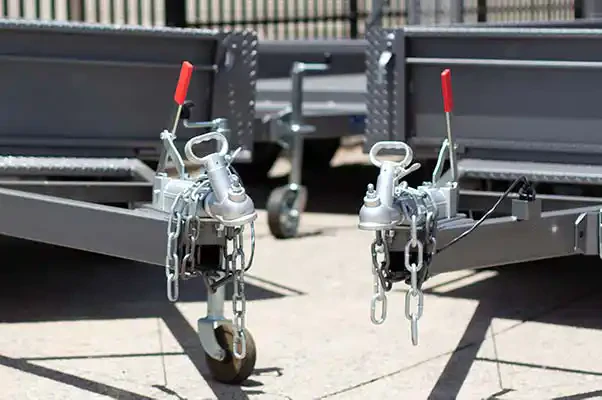
Once in position, use the jockey wheel to lower the coupling down onto the tow ball and close the hitch locking mechanism. If you can't lift the trailer off, you can be confident that it's properly secured. The next step is to connect the two safety chains, crossing them over for added security. The final step is to connect the trailer plug and check that the tail lights, indicators, hazard lights and number plate lights are working and in sync with the towing vehicle.
Need more advice on safe towing a trailer?
No-one knows more about towing trailers in Adelaide than we do, so if you want some advice on matching the right sort of trailer with your vehicle, don't hesitate to get in touch.
Call the friendly team at Basic Trailers on 1300 770 770, email info@basictrailers.com.au or visit our workshop in Pooraka and we'll be happy to advise you as the best sort of vehicle and trailer combination for your needs.
Towing vehicle and trailer FAQs
What do I need to know about combined weight limits when selecting a tow vehicle?
If you want to know the maximum weight your vehicle can tow, it is helpful to understand kerb weight (vehicle weight with no load), Gross Vehicle Mass (the kerb weight plus passengers), Gross Combination Mass (GVM plus trailer weight), Aggregate Trailer Mass (weight of the trailer when fully loaded but not hitched to a tow vehicle), and Gross Trailer Mass (the loaded trailer weight when coupled to a vehicle).
However, towing capacity is most commonly based on the vehicle's maximum ATM, as set out in the owner's manual.
What are the best types of tow bars for towing a trailer?
There are three main types of tow bar in Australia, and which are classified by design and capacity.
Class 2 flat tongue tow bars are suitable for towing light trailers with an ATM up to around 1,600 kg ATM. Class 3 horizontal hitch tow bars feature a a horizontal hitch receiver and are rated up to about 1,600 kg ATM. Class 4 horizontal hitch tow bars are highly versatile, and rated up to 3,500kg ATM. They feature a horizontal hitch and safety chains , and support 50mm tow balls and load distributing devices.
Class 4 tow bars are recommended for towing large caravans, horse floats and heavier trailers, including car trailers, plant trailers, boat trailers, tipper trailers, scissor lift trailers and more.
What sort of engine and transmission are best for towing heavier trailers?
Automatic transmissions are generally preferred for vehicles regularly towing a trailer as they offer better fuel efficiency and smoother gear shifts. When towing trailers with an ATM above 2,800kg, engines with strong low-range torque offer the best performance particularly if you have to climb hills.
What are Australian standards and towing regulations that can influence the choice of tow vehicle?
It is essential to adhere to the towing capacity set out by the vehicle's manufacturer in the owner's manual, as failing to do so can lead to a fine and demerit points. It can also mean that you are not able to tow safely and in addition to putting yourself and other road users at risk, it can also void warranties and insurance. Therefore, if you need to tow a trailer with a high aggregate trailer mass regularly, ensure that you choose a tow vehicle that has an appropriate maximum towing capacity.
What type of vehicle is generally recommended for regular trailer towing in Australia?
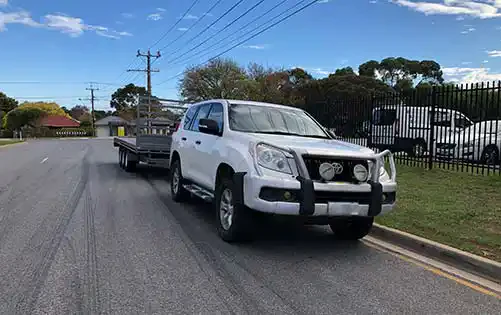
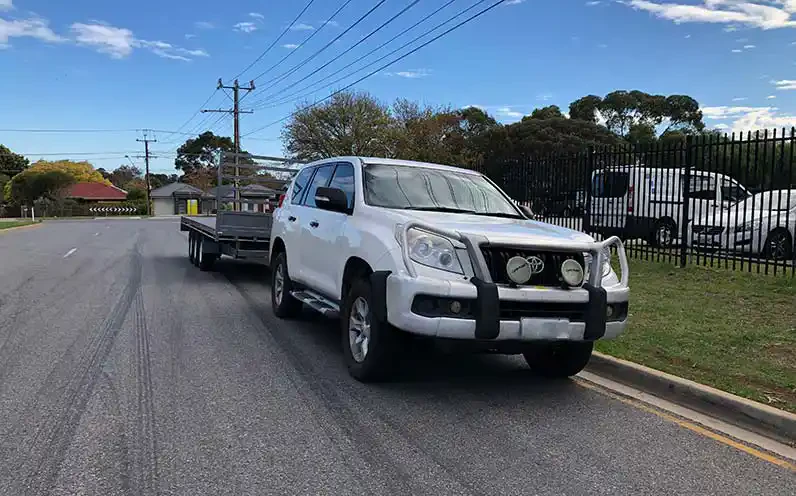
The most popular towing vehicles in Australia include 4WDs, larger SUVs, pick-ups and dual-cab utes. What these have in common tends to be strong torque, automatic transmission, and a wide wheel base for stability.
However, if you only ever tow a relatively light, single axle trailer, most cars that are fitted with safe towing equipment from a reputable towbar manufacturer, plus extra mirrors, should be adequate for safe towing.